
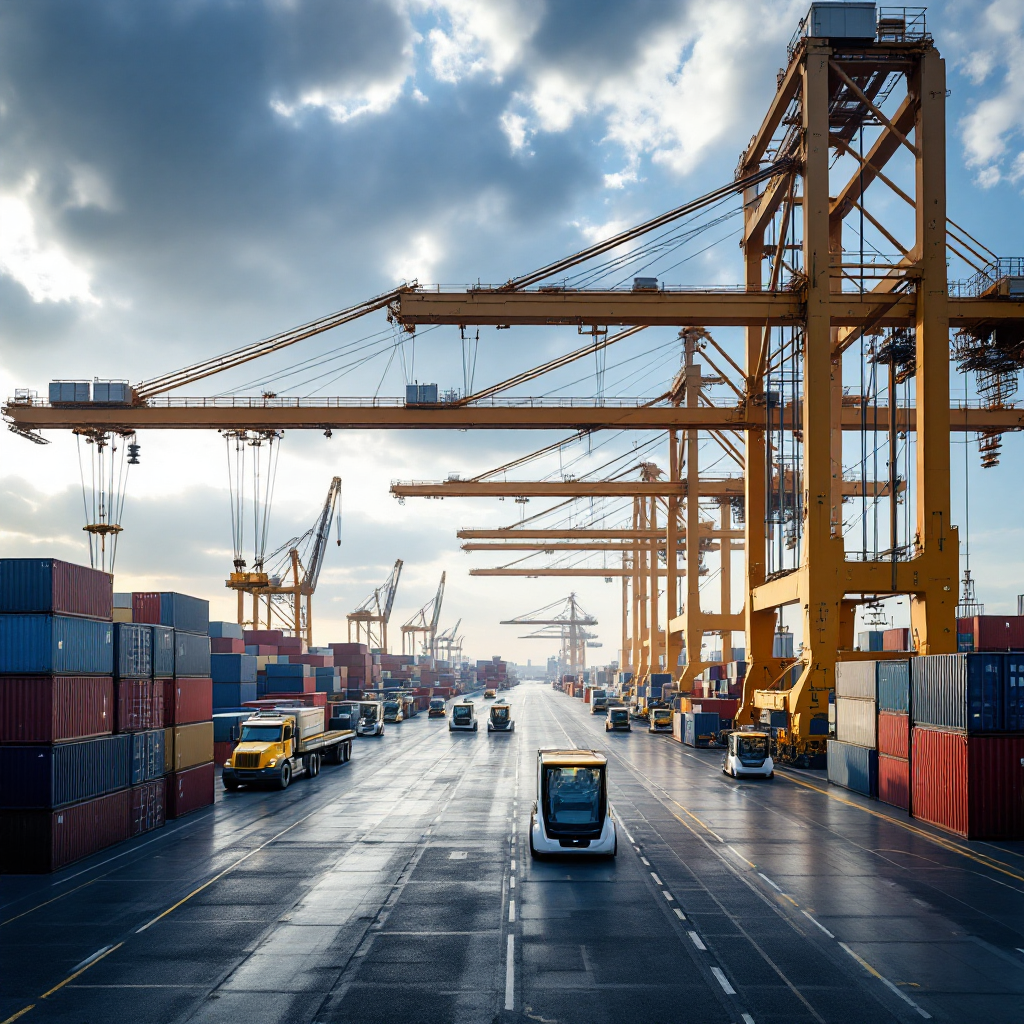
real-time Scheduling Fundamentals in Terminal Operations
Real-time scheduling means making assignment decisions continuously, not in batches. In contrast, static or batch methods set plans ahead and rarely change them. Real-time systems ingest streams and adapt immediately. They reduce idle times, speed recovery from disruptions, and keep flow steady. For a container terminal, this distinction matters greatly. A static plan can leave quay cranes waiting, while a real-time approach reassigns tasks to keep work moving.
Terminal tasks include container loading and unloading at berths, yard management, and gate operations. Quay cranes lift boxes from ships. Yard cranes stack containers in yards. AGVs move containers between quay and yard. Gate operations handle truck arrivals and departures. Each task creates dependencies. The scheduling problem spans equipment, personnel, and time. Operators must consider container sequences, arrival windows, and completion time targets.
Real-time data feeds inform scheduling decisions. Sensors, IoT devices, and operational databases stream location, status, and equipment health. CCTV, RFID, and PLC systems provide position and weight. Terminal operating systems store booking, vessel, and truck data. When combined, these sources support an integrated scheduling model that drives dynamic action. For more on tying yard data into planning, see our piece on next-generation yard planning software next-generation container terminal yard planning.
Benefits accrue quickly. Terminals that adopt real-time frameworks report lower wait times and higher throughput. Studies show handling-time reductions near 15–25% when terminals move to automated, adaptive schedules (digital readiness study). Also, a market analysis predicts adoption growth for autonomous equipment at over 20% CAGR through 2030, driven by these gains (market potential). This reduces friction in exchanges that would otherwise slow manual rescheduling. Thus, operations teams can act faster and with better data.
Real-time scheduling supports integrated scheduling of handling across equipment types. It targets continuous flow and reduced non-productive moves. As a result, terminals see improved operational efficiency. First, planners must map data sources. Next, they must choose algorithms and interfaces that react within seconds. Finally, they validate outcomes against KPIs such as throughput and task completion time.
optimize Throughput with Autonomous AGVs and Quay Cranes
Throughput, turnaround time, and energy use define performance. Operators measure these to guide scheduling decisions. Throughput tracks containers moved per hour. Turnaround time measures how long a vessel stays at berth. Energy use captures power consumed by cranes and AGVs. When optimizing container terminal workflows, teams aim to raise throughput, cut turnaround, and lower energy consumption.
Coordination between AGVs and quay cranes poses special challenges. Cranes often finish a lift before an AGV arrives. Conversely, AGVs can queue at the quay and block the lane. Synchronization must prevent both crane idle time and AGV congestion. Planners use time windows and dynamic buffers to align movements. They also monitor equipment failure signals and adjust paths when issues appear. Scheduling in automated container terminal contexts must account for these interactions continuously.
Common optimization goals include minimising travel distance and balancing workload across cranes and yard cranes. Reducing empty moves lowers energy consumption and operating costs. Balancing workload prevents a single quay crane from becoming a bottleneck. Practical techniques range from simple rule-based heuristics to more advanced model predictive control. Heuristics work when system dynamics stay predictable. Model predictive control looks ahead and solves short horizon problems frequently, which helps absorb variance in container arrival and handling time.
One real approach stitches short-term planning with longer forecasts. First, assign quay crane time slots that meet berth allocation goals and vessel constraints. Then, schedule agv runs to those slots while minimising travel and wait times. This approach reduces maximum completion time and improves resource utilization. For details about reducing non-productive moves, review the predictive equipment repositioning study predictive equipment repositioning.
Practical deployments must also handle faults. For instance, considering quay crane faults and their ripple effect on the agv scheduling problem helps avoid cascading delays. A mixed strategy that combines simple dispatch rules with periodic re-optimisation works well. Finally, teams must measure and tune energy consumption and operation time to meet sustainability and service targets.
Drowning in a full terminal with replans, exceptions and last-minute changes?
Discover what AI-driven planning can do for your terminal
AI and optimization Techniques for Dynamic Scheduling
AI now plays a central role in dynamic scheduling. Machine learning, reinforcement learning, and neural nets can predict demand, estimate handling time, and propose allocations. Reinforcement learning and deep reinforcement learning learn policies that map state to action for sequential decision problems. These learning algorithm approaches adapt to changing patterns and can outperform static heuristics in many scenarios.
However, learning-based adaptability competes with scheduling stability. Frequent changes to an active schedule can create operational churn. Therefore, systems should balance adaptiveness and stability. For example, a policy may allow only high-confidence reassignments, or it may enforce minimum dwell times for assigned tasks. A hybrid method often yields the best result. It combines AI policy proposals with rule-based constraints that respect safety and operational limits.
Hybrid methods couple neural nets for prediction with constraint solvers for feasibility. A neural net might estimate container arrival probability or handling time. Then, an algorithm solves an integrated scheduling model to produce feasible assignments. This pattern supports automated container terminal decision-making under uncertainty. Research surveys on AI-enabled dynamic scheduling provide insights on this balance (AI-enabled survey).
Computational requirements matter. Real-time decision windows often span seconds to a few minutes. That constraint limits model complexity. Teams therefore use lightweight models for immediate dispatch and heavier models for periodic re-optimisation. Cloud CPUs and edge compute nodes share the load. They satisfy latency needs and keep models current with real data streams. In practice, operation teams run simulations offline to validate policies before live rollout.
AI systems must also integrate with terminal systems. That integration covers scheduling system interfaces, data ingestion pipelines, and alerting channels. It extracts intent from messages and routes issues to the right control team, so scheduling teams spend less time on manual triage. Finally, teams should instrument models for explainability and rollback, so planners can trust automated decisions and intervene when needed.
allocation and dispatch Algorithms for Autonomous Equipment
Allocation assigns jobs to AGVs, cranes, and yard trucks. Dispatch decides sequence and routes. Both functions work together to shape daily operations. Good allocation reduces travel time and balances machine wear. Good dispatch minimises queue lengths and prevents collisions. Together they lower task completion time and raise utilization.
Popular allocation strategies include first-come-first-serve and shortest processing time. Auction-based methods let equipment bid for tasks based on cost functions. Auction approaches provide decentralised flexibility. An algorithm is proposed in many studies to match tasks quickly while respecting local constraints. For more on equipment task allocation methods, see the AI-driven allocation research AI-driven equipment task allocation.
Dispatch often uses sequencing heuristics. Simple rules assign the nearest idle AGV to the next job. More complex methods plan routes and buffers to avoid deadlock. The agv scheduling problem includes route planning, battery constraints, and charging windows. Some systems adopt rolling-horizon optimisation that re-evaluates sequences periodically. These systems balance responsiveness with the risk of excessive rescheduling.
Auction and market-based approaches shine when scaling across many assets. They decentralise decisions and reduce a central solver’s burden. Conversely, centralised solvers can enforce global constraints and optimise for aggregate KPIs. Each choice creates trade-offs: responsiveness versus computational load, and local efficiency versus global optimality. Teams often implement hybrid schemes that run central optimisation for strategic plans and local auctions for tactical dispatch.
When designing these systems, engineers must track metrics such as equipment busy rate, queue lengths, and average wait times. They must also plan for edge cases like equipment failure and unexpected container arrival spikes. Considering quay crane faults in the allocation model helps the system reassign tasks without human intervention. The right mix of algorithms and rules keeps operations robust and predictable.

Drowning in a full terminal with replans, exceptions and last-minute changes?
Discover what AI-driven planning can do for your terminal
utilization Metrics and Performance Analysis
Utilization metrics tell you how well assets serve demand. Key indicators include equipment busy rate, queue lengths, and waiting times. Busy rate measures the fraction of time a crane or AGV performs useful work. Queue length counts pending tasks. Waiting time records the delay between task ready time and start. These numbers guide iterative improvements and staffing decisions.
Data collection relies on sensor feeds and terminal operating system logs. Real-time data from PLCs, RFID, and GPS provide device-level telemetry. System logs capture bookings, job states, and exception notes. Teams merge these streams into a time-series store. Then, they compute indicators and trigger alerts if thresholds break. For examples of using PLC data to power AI, see the PLC-driven optimization discussion PLC data to power AI.
Dashboards present metrics in actionable ways. One panel shows quay crane utilization by shift. Another plots AGV queue lengths near the quay. A third displays gate operations throughput and truck wait times. Visuals help planners spot trends and anomalies fast. They also feed back into scheduling models so planners can test hypotheses and tune decision thresholds.
Metrics also drive predictive maintenance. High vibration, rising energy consumption, and deviation in handling time can indicate equipment failure. Detecting these early reduces downtime and keeps utilization high. Research on predictive repositioning links equipment moves to non-productive time reduction and improved utilization predictive repositioning.
Finally, linking performance analysis to staffing and communication workflows reduces friction. For instance, automating the triage of exception emails frees planners to focus on optimising schedules. That automation reduces manual overhead and maintains a clearer audit trail for operational decisions.
case study: berth allocation and gate operations at an Automated Container Terminal
This case study examines a port that implemented automated scheduling to coordinate berth allocation and gate operations. The port replaced manual rosters with a scheduling system that integrates berth allocation, quay crane scheduling, and AGV dispatch. They targeted vessel turnaround and gate wait times in a unified model. The result: container handling time dropped significantly and service reliability improved.
Berth allocation changes mattered most. By linking berth allocation decisions to crane and AGV schedules, the terminal cut vessel turnaround by about 15–25% in measured trials (digital readiness study). The integrated berth allocation and quay crane coordination reduced idle crane minutes and improved container sequences at the quay. The integrated scheduling problem included constraints for crane interference and yard crane availability.
Gate operations gained from dynamic slotting. Truck arrivals vary and queues form. The terminal introduced a dynamic gate scheduling scheme that assigns time points to incoming trucks. As a result, truck wait times fell and yard congestion eased. The system used a scheduling model that reoptimised on new arrivals and equipment events. For a deeper look at berth call optimisation and congested terminals, review the berth call strategies article berth call optimization strategies.
The team also tested learning methods. They used a reinforcement learning algorithm to adjust slot pricing and gate window lengths. The reinforcement learning algorithm balanced throughput and truck wait times. It learned to shrink windows during peak days and expand them when arrival rates dropped. This learning improved gate throughput without excessive rescheduling.
Key lessons emerged. First, an automated terminal gains most when it combines allocation decisions across berth, quay crane, and yard operations. Second, data quality matters; planners must feed real data into models to avoid drift. Third, human oversight remains essential for exceptions and for validation of extreme decisions. Finally, ongoing research will focus on interoperability standards and broader adoption of integrated scheduling of handling equipment in automated container environments. Future work will test hybrid scheduling models and refine crane scheduling under fault conditions to further improve operation efficiency and reduce the maximum completion time for complex vessel calls.
FAQ
How does real-time scheduling differ from batch scheduling?
Real-time scheduling updates assignments continuously as new data arrives. Batch scheduling creates plans at fixed intervals and rarely adapts between cycles. The former reduces idle time and responds faster to disruptions.
Which equipment benefits most from dynamic allocation?
Quay cranes, AGVs, and yard cranes benefit strongly from dynamic allocation. Each device has interdependencies that dynamic allocation can exploit to reduce travel and wait times. Together they improve terminal throughput.
Can reinforcement learning handle quay crane scheduling?
Yes. Reinforcement learning and deep reinforcement learning can learn policies for complex sequencing and coordination tasks. They work best when combined with rule-based constraints to ensure safe, stable operations.
What data sources feed a real-time scheduling system?
Sensors, IoT devices, RFID, PLCs, and terminal operating system logs form the primary data sources. These streams provide location, status, and booking data that scheduling models require. High-quality data enables more accurate predictions.
How do operators avoid excessive rescheduling?
Teams impose stability constraints and confidence thresholds on automated changes. They also use rolling horizons and only commit changes with sufficient benefit to justify disruption. This balances responsiveness and predictability.
What metrics should terminals monitor for utilization?
Monitor equipment busy rate, queue lengths, average waiting times, and energy consumption. These metrics show how well assets serve demand and where bottlenecks form. Dashboards make trends visible in real time.
How does automated email handling support scheduling teams?
Automated email agents extract intent and data from inbound messages and route them appropriately. This reduces manual triage and speeds decision-making during exceptions.
What are common trade-offs in allocation algorithms?
Centralised algorithms achieve global optimality but require more compute and coordination. Decentralised methods like auctions scale well but may miss global optima. Hybrid approaches blend both strengths and reduce trade-offs.
How much improvement can terminals expect from automation?
Case studies and market research report handling time reductions of 15–25% and productivity improvements up to 30% in related warehouse scenarios (order picking study). Actual gains depend on implementation quality and data maturity.
Where can I learn more about integrating berth and yard planning?
See resources on integrating vessel planning and yard planning to explore models and implementation steps. The integrated approach improves berth allocation and reduces non-productive moves integrating vessel and yard planning.
our products
 stowAI
 stackAI
 jobAI
jobAI
Innovates vessel planning. Faster rotation time of ships, increased flexibility towards shipping lines and customers.
Build the stack in the most efficient way. Increase moves per hour by reducing shifters and increase crane efficiency.
Get the most out of your equipment. Increase moves per hour by minimising waste and delays.
stowAI
Innovates vessel planning. Faster rotation time of ships, increased flexibility towards shipping lines and customers.
stackAI
Build the stack in the most efficient way. Increase moves per hour by reducing shifters and increase crane efficiency.
jobAI
Get the most out of your equipment. Increase moves per hour by minimising waste and delays.