

Overview of container terminals and quay crane operations
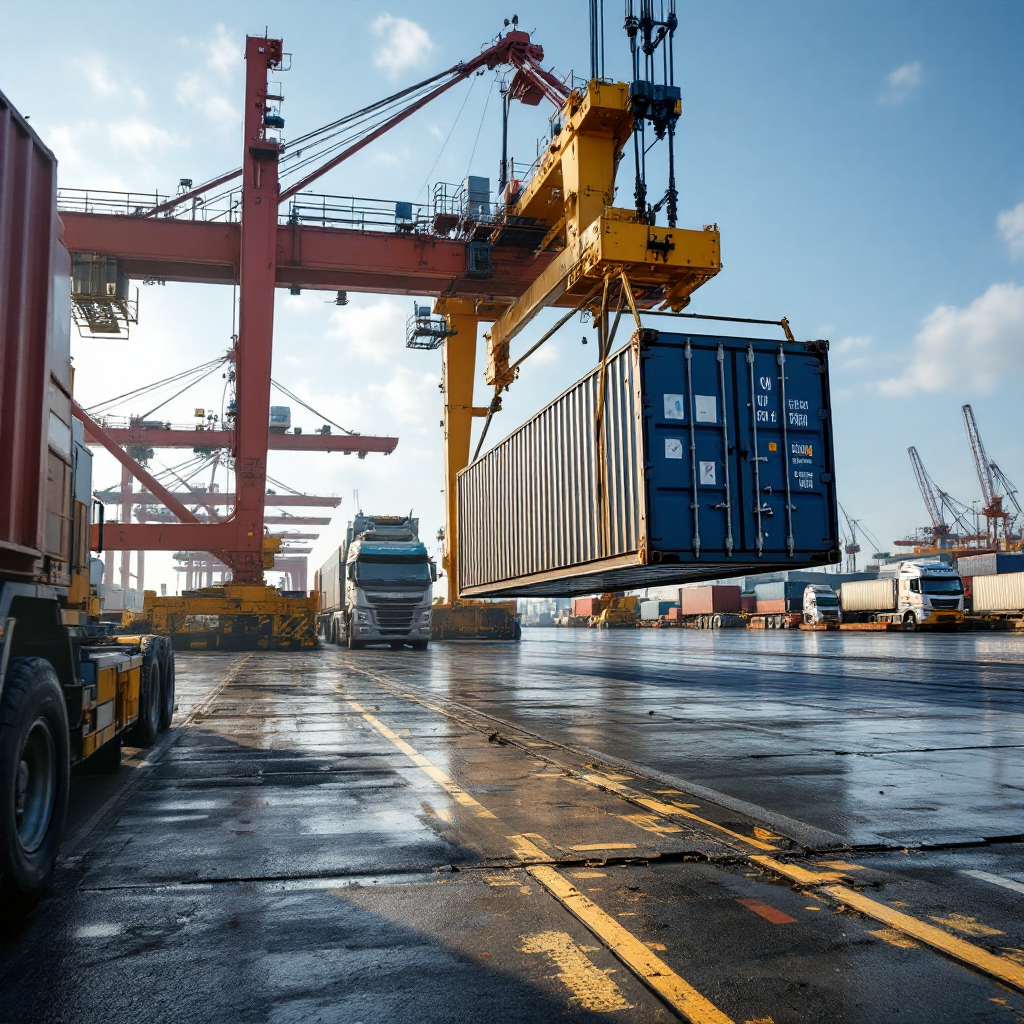
Container terminals move boxes between ships and landside transport. They sit at the centre of maritime logistics, and they depend on reliable handling equipment. Quay cranes perform the primary task of ship-to-shore transfers. These cranes lift containers from container ships and place them onto trucks, agvs or yard cranes. They also perform the reverse when loading a ship. Effective QUAY CRANE control shortens berthing time. Therefore, ports can increase throughput and serve more vessels per week.
Key performance indicators drive decisions at terminals. First, vessel turnaround time measures how long a ship spends at berth. Second, crane utilisation shows the share of available time each crane actively lifts. Third, yard efficiency and truck flow affect overall throughput. Operators track container handling metrics, such as moves per hour, and energy consumption while cranes run. For example, research reports that many automated container terminal sites still require human oversight and that none have reached end-to-end autonomy for quay crane operations The Impact of Automation on the Efficiency of Port Container Terminals. This fact clarifies why scheduling remains a focus for improvement.
Quay procedures combine berth allocation, stowage planning and task scheduling. Ports must balance competing priorities. For instance, a busy inbound of container ships demands fast and conflict-free allocation and quay crane assignment. Also, cranes must avoid interference when they operate side-by-side. In practice, terminals use berth plans and a scheduling system to sequence crane tasks. In addition, simulation supports planning for peak windows. For operators who want more context on digitization and the path toward smart yards, see the container terminal digitalization roadmap digitalization roadmap.
Performance metrics in container terminals: throughput and utilisation
Metrics matter because decisions rest on numbers. If planners improve crane utilisation, they can lower vessel turnaround time. Studies quantify these gains. Optimized scheduling algorithms can raise quay crane utilisation by 15–20% and reduce vessel turnaround by roughly 10–12% Automated Container Terminal Production Operation and Scheduling. Also, integrated approaches that coordinate truck windows with quay tasks unlock latent capacity Collaborative Optimization of Truck Scheduling in Container Terminals. These numbers explain why ports invest in integrated scheduling tools and simulation platforms.
Compare manual terminals and semi-automated sites. Manual sites still hold about 69% market share, while fully automated sites grow at a CAGR of 4.10% through 2024 Container Terminal Operations Market Forecasts 2030. So, most terminals remain partly or fully manual today, yet they adopt software to optimize operations. For many terminals, a U-SHAPED AUTOMATED CONTAINER TERMINAL design appears attractive because it reduces distances for yard cranes and AGVS. Therefore, ports test new layouts and scheduling strategies to gain step changes in productivity.
Performance ties to equipment and process. For example, dual cycling loading and coordinated truck windows reduce idle time for quay assets. In practice, terminals monitor crane productivity and adjust allocation and quay crane assignment to match vessel work patterns. To read practical suggestions on cutting idle time at the quay, consult a resource on reducing crane idle time in deepsea ports reducing crane idle time. In short, metrics guide both capital investments and day-to-day sequencing decisions.
Drowning in a full terminal with replans, exceptions and last-minute changes?
Discover what AI-driven planning can do for your terminal
Genetic algorithm in quay crane scheduling: principles and benefits
Genetic algorithm methods borrow ideas from natural selection. They start with a population of candidate schedules. Then they apply crossover and mutation operators to create new variants. Next, they evaluate each candidate using a fitness function. The fitness function often balances vessel turnaround, crane utilisation and truck delay. Over iterations the population evolves. The best schedules survive and improve. As a result, planners obtain robust solutions for complex scheduling problems.
Genetic algorithms offer advantages for the quay crane scheduling problem. They handle discrete choices, they adapt to many constraints, and they scale to large terminals. For example, a genetic algorithm can reschedule tasks in real-time after a delay or a changed truck pattern. This approach reduces idle time and improves scheduling efficiency. Case study evidence shows GAs improved gate and crane OCR performance and helped synchronize yard cranes with quay tasks in practice Enhancing Crane and Gate OCR Efficiency at Container Terminal. Also, GAs integrate naturally with hybrid heuristics. Therefore, planners combine exact steps for critical decisions and genetic searches for broader sequencing.
Implementation details matter. Effective GA designs use problem-specific encoding of moves, repair operators that enforce constraints, and multi-objective fitness to balance throughput and energy consumption. In addition, they can incorporate constraints such as interference avoidance and stacking cranes limits. For terminals that include agvs, AGVS and agvs scheduling interfaces let the genetic algorithm evaluate end-to-end flows. Moreover, combining GA with an optimization model increases the chance to obtain the best schedule under tight time budgets. For more on integrated vehicle and terminal scheduling, review the AI-driven quay crane scheduling and yard optimization guide AI-driven quay crane scheduling and yard optimization.
Solution approach: exact and heuristic algorithms for integrated scheduling
Solution approach choices shape performance. Exact methods such as mixed integer programming solve small but critical subproblems to optimality. For tandem-lift or tandem quay crane operations, exact algorithms allocate paired tasks when dual spreader use is possible. Such techniques reduce the problem of interference and coordinate dual-lifts precisely An Exact Algorithm for Scheduling Tandem Quay Crane Operations. On the other hand, heuristic and metaheuristic strategies, including genetic algorithm and particle swarm optimization, scale to the full berth and yard interactions.
Integrated scheduling optimization covers multiple subsystems. For instance, planners must handle berth allocation and quay crane, yard crane and agv sequencing. The integrated quay crane decisions must respect yard crane scheduling problem constraints and stacking cranes limits. To reconcile competing objectives, a cooperative scheduling framework layers exact solvers for critical allocations and heuristics for task sequencing. This blend improves scheduling efficiency and offers real-time responsiveness.
Constraint handling is essential. Algorithms enforce interference avoidance rules, they model mixed lift modes such as single-lift and tandem-lift, and they include loading and unloading mode switches. They also consider yard crane and agv scheduling to avoid bottlenecks. For terminals that adopt a dual-cycle operation, the model coordinates horizontal transport and quay cycles to save moves. Further, optimization models may include energy consumption and maintenance and scheduling windows for equipment. When an operator needs to solve the integrated scheduling problem, this hybrid approach provides pragmatic balance between optimality and speed.
Drowning in a full terminal with replans, exceptions and last-minute changes?
Discover what AI-driven planning can do for your terminal
Software implementation for automated quay crane scheduling
Software turns algorithms into operational gains. A typical system architecture includes data inputs, an optimization engine and a user interface. Data inputs stream from the TOS, berth plans, vessel stowage, truck appointments and equipment telemetry. Then, the optimisation engine runs scheduling optimization and produces a sequencing plan that guides quay crews and AGVS. Finally, the user interface surfaces exceptions and permits fast overrides. The scheduling system must also export tasks to the yard and to the gate.
Integration matters across layers. A robust solution links to the terminal operating system, to automated yard controllers, and to agvs and ascs. In practice, integration with an automated yard controller lets the software synchronize AGVS and stacking cranes. Also, coupling with simulation enables what-if analysis for terminal conditions and capacity tests. For example, operators run simulation scenarios to validate a scheduling model before live deployment Scheduling of Automated Guided Vehicles for Tandem Quay Cranes. In addition, a scheduling engine that supports dynamic scheduling can reassign tasks when delays occur or when energy constraints appear.
Operational readiness requires automation of related processes. Email, for instance, drives routine task changes and ad-hoc updates. The platform parses inbound requests, pulls data from ERP or WMS, and updates the scheduling system or alerts planners. This reduces manual triage and keeps the optimization loop lean. For other practical methods to improve terminal throughput, see container terminal productivity improvement strategies productivity improvement strategies. Finally, connectors to predictive maintenance systems keep gantry cranes and other automated equipment available and aligned with planned operations.
Future directions in container terminals automation and AI integration
Future systems will blend machine learning with operations research. Machine learning provides predictive scheduling. For example, models forecast truck arrivals, berth delays and handling times so the optimization engine acts before disruptions occur. Then, an operations research core, often mixed integer programming for allocations and heuristic search for sequencing, applies those forecasts to produce resilient plans. Together, these capabilities improve scheduling in automated container terminals and help solve scheduling problems under uncertainty.
Key challenges remain. Equipment heterogeneity creates complexity. Terminals run cranes, stacking cranes, AGVS and gantry cranes with different capabilities. Also, real-time data quality often lags ideal. Therefore, software must tolerate noise and fill gaps with safe defaults. Full autonomy demands proven safety and standardization, which the industry continues to build. For u-shaped automated container terminal layouts, integrated scheduling optimization of u-shaped designs offers clear distance advantages but requires custom optimization of u-shaped automated container flows and integrated scheduling of agvs real-time yard optimization strategies.
Research highlights several promising directions. First, cooperative scheduling that jointly optimizes berth allocation and quay crane performs well on throughput metrics. Second, energy-aware scheduling reduces consumption and costs. Third, hybrid algorithms that combine genetic algorithm searches with exact subproblem solvers increase resilience. For readers interested in concrete modeling techniques, mixed integer programming, particle swarm optimization and genetic algorithm approaches appear in recent studies. In addition, practical deployments need tight change management, since planners must trust the scheduling recommendations and since maintenance and scheduling windows must align with operations in container.
Finally, the path ahead includes improved interfaces between decision systems and human teams. As automation and AI mature, terminals will achieve higher crane productivity, lower energy consumption and smoother transshipment flows, while keeping operators in the loop to manage exceptions and unusual events.
FAQ
What is an integrated quay crane scheduling system?
An integrated quay crane system coordinates berth planning, quay crane assignment and supporting yard and truck scheduling. It combines optimization engines and real-time data to sequence moves and to reduce conflicts.
How much can scheduling optimization improve performance?
Optimized scheduling can raise quay crane utilisation by around 15–20% and reduce vessel turnaround time by approximately 10–12% according to recent studies Automated Container Terminal Production Operation and Scheduling. Results vary by terminal layout and execution quality.
Are quay cranes in automated container terminals fully autonomous?
Not yet. Research indicates none of the existing automated container terminals operate completely without human oversight for quay crane activities The Impact of Automation on the Efficiency of Port Container Terminals. Human supervision still plays an important role.
What role do agvs and AGVS play in scheduling?
AGVS move containers between quay and yard, so their schedules must align with crane moves to avoid idle time. Integrated vehicle and yard crane coordination reduces congestion and improves throughput.
Can genetic algorithm approaches run in real-time?
Yes. Well-designed genetic algorithm implementations can reschedule quickly after disruptions. They combine fast heuristics with repair operators to meet real-time constraints and to address common scheduling problems.
How does energy consumption factor into scheduling?
Scheduling can minimize crane idle runs and peak draws, thereby lowering energy consumption. Optimization models that include energy as an objective help terminals cut costs and emissions.
What is a tandem-lift or tandem quay crane strategy?
Tandem-lift operations use two cranes to handle a single heavy container or to speed moves with dual spreaders. Exact algorithms can assign tandem lifts to maximize throughput while avoiding interference An Exact Algorithm for Scheduling Tandem Quay Crane Operations.
How do terminals test new scheduling models safely?
They use simulation to validate scheduling models under realistic terminal conditions and traffic patterns. Simulation exposes weaknesses before live rollout and helps to tune parameters for dynamic scheduling.
What integrations are essential for a scheduling system?
Core integrations include the TOS, berth planning, yard crane controls, gantry cranes, gate systems and maintenance data. Also, email and task notifications matter; automation of those workflows streamlines operations.
How can smaller terminals begin upgrading scheduling without full automation?
Start with targeted improvements such as improving truck appointment coordination and reducing crane idle time. Resources on reducing yard and gate congestion and on productivity strategies provide a practical roadmap reducing yard and gate congestion and productivity improvement strategies.
our products
 stowAI
 stackAI
 jobAI
jobAI
Innovates vessel planning. Faster rotation time of ships, increased flexibility towards shipping lines and customers.
Build the stack in the most efficient way. Increase moves per hour by reducing shifters and increase crane efficiency.
Get the most out of your equipment. Increase moves per hour by minimising waste and delays.
stowAI
Innovates vessel planning. Faster rotation time of ships, increased flexibility towards shipping lines and customers.
stackAI
Build the stack in the most efficient way. Increase moves per hour by reducing shifters and increase crane efficiency.
jobAI
Get the most out of your equipment. Increase moves per hour by minimising waste and delays.