
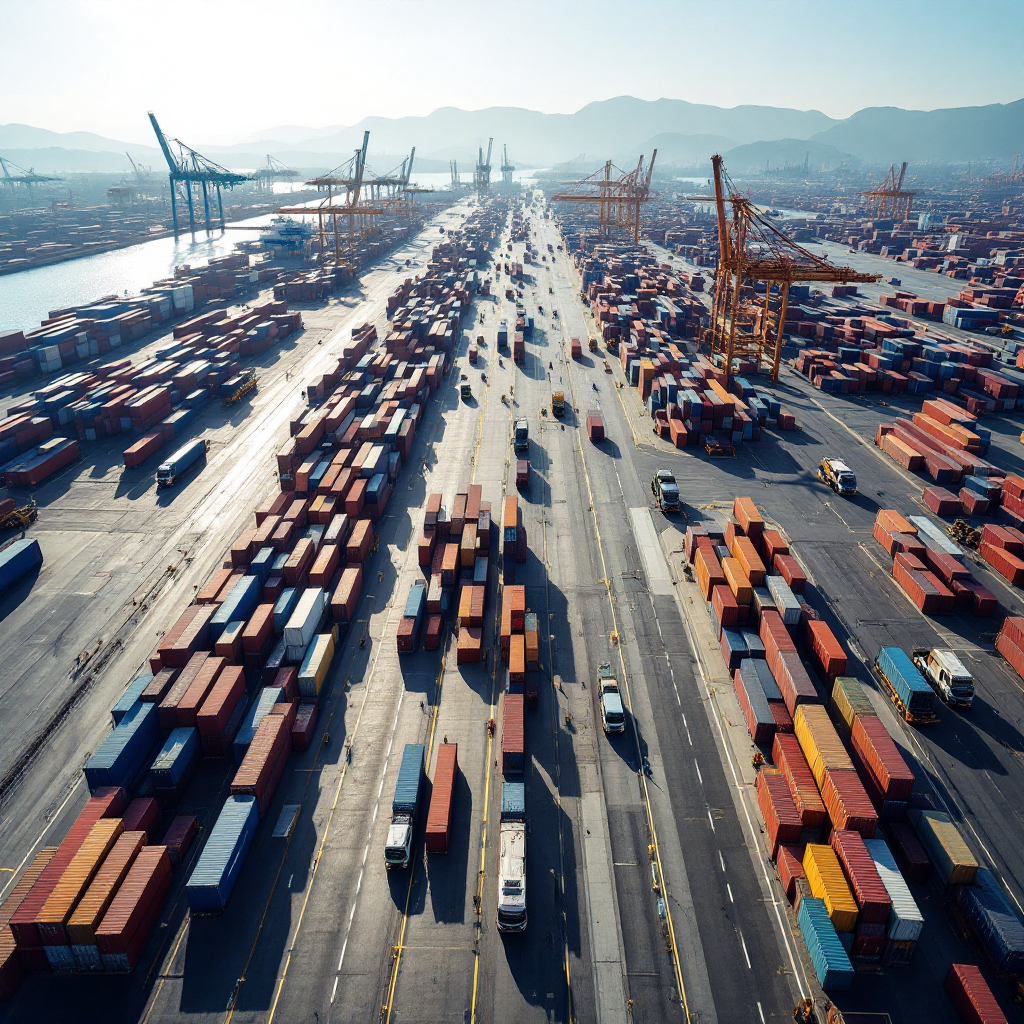
Terminal and Container Yard Fundamentals
The terminal sits at the centre of maritime logistics and acts as the hub for vessel loading and unloading. A terminal must coordinate berth arrivals, yard placement, and landside handovers. Efficient terminal design reduces delays and lowers operational costs, and it boosts productivity for port operators and shipping lines. The container yard is the main space where containers wait between ship and truck or rail. Good yard layout, block design and storage zoning shorten internal travel and help minimize rehandling. Key performance indicators for any terminal include throughput, dwell time, and space occupancy. Throughput measures the flow of TEUs in and out, and dwell time measures how long each container stays in the yard. Space occupancy tracks yard utilization so managers can avoid overcrowding and empty stacks that waste storage space.
Operators balance several constraints. They must set stack height limits to protect cranes and to accommodate weight rules. They must also control container slot assignment to reduce reshuffle and container relocation. For that reason, yard block design groups like cargo type, export versus import, and reefer positions are common. Terminals that track container movement closely can better position containers near the berth and external trucks. This yields faster vessel turnaround and lower operational costs. A well-tuned yard reduces bottleneck risk, and it allows the terminal to handle surges in arrival without adding physical space. Terminal operators use simple rules and more advanced heuristics to predefine where to place inbound boxes. Those rules guide yard crane operators and truck drivers, and they support a smoother flow.
Terminal performance relies on both people and systems. Human operators still set priorities in many ports, and they must read manifests, check container condition, and coordinate external trucks. At the same time, automation and digital tools can speed routine decisions, and they can free staff to handle exceptions. When email triage is removed, teams respond faster to arrivals and to shifts in yard utilization. The combined effect is measurable: improved throughput, reduced dwell time, and fewer non-optimal container moves.
Container Terminal Yard Literature Review and Optimization Objectives
Research on yard planning and stacking covers decades. The literature review highlights methods from operations research and from heuristic search. Studies show that data-driven yard layout design and resource allocation yield measurable gains. For instance, industry analysis finds that improvements in yard planning and resource optimization can reduce vessel turnaround times by up to 20% (Terminal YardOptimization | OptiFlow Port Solutions). Academic work adds that container stacking strategies and equipment configuration influence operational efficiency by as much as 15–25% (Data-Driven Analysis and Optimization of Container Terminal Operations). Case studies from automated designs report 10–18% improvements in handling rates versus traditional layouts (Mathematical modeling and optimizing of yard layout in automated …). Another operational case in Turkey used integer optimization to reduce yard clashes by 15% (Container Terminal Yard Optimisation: A Case In Turkey).
The core objectives that emerge from these studies are straightforward. First, maximise space utilization by arranging yard blocks and by limiting empty stacks. Second, minimise container handling time to speed vessel turnaround and to lower operational costs. Third, balance workload across yard blocks to avoid bottleneck and to keep cranes and trucks productive. Fourth, reduce travel distance for cranes and trucks so fuel use and cycle time fall. Those objectives support a terminal’s commercial goals and its role in global trade. Designers often set quantified targets for each objective. For example, a program to optimize yard block assignments may aim to reduce internal truck travel by a set percentage and to limit reshuffle moves per arrival. Projects that combine algorithmic planning with real implementation often report the greatest gains. The studies also stress that a single optimal solution rarely fits all terminals. Each port must evaluate its traffic mix, berth schedule, and landside patterns before selecting tools and procedures.
Drowning in a full terminal with replans, exceptions and last-minute changes?
Discover what AI-driven planning can do for your terminal
Heuristic Methods for Container Stacking and Stack Efficiency
Heuristic algorithms are now standard tools to solve large yard planning problems where exact models are too slow. Common methods include genetic algorithms, tabu search, and simulated annealing. Each method trades off search speed and solution quality. Genetic algorithms evolve candidate arrangements, and they work well when the search process must explore many combinations of yards and stack containers. Tabu search prevents cycling back to recent placements, and it excels when a terminal must escape local minima. Simulated annealing accepts worse moves early and then tightens the search, and it can find near-optimal patterns for complex stacking constraints.
Practical stacking rules guide these methods and guide on-the-ground work. Terminals set stack height limits and vertical tiers to match crane reach and safety codes. They also order stacks by retrieval urgency, with imminent discharge boxes placed near aisle access. Weight considerations matter: heavy containers must not sit above lighter ones, and hazardous cargo must go to approved blocks. Many terminals use a rule-based system to predefine which blocks receive export loads and which hold import returns. Those predetermined rules reduce operator uncertainty and reduce reshuffle. Yet heuristic systems can improve over static rules by adjusting to live flows, and they can lower container relocation and empty stacks.
Stack efficiency directly affects reshuffle rates and crane productivity. Fewer reshuffle moves mean shorter cycles and less wear on handling equipment. Research shows that better stacking can influence operational efficiency by up to 25% in some designs (Data-driven analysis). Terminals combine heuristics with local rules for robust outcomes. They also test strategies in simulation before deployment. For readers who want deeper technical context, a review of machine learning use cases in port operations explains how data-driven models help assignment and repositioning decisions (machine learning use cases in port operations). In practice, a hybrid approach—rules plus heuristic search—often yields the best trade-off between safety, predictability, and improved stack density.
Optimize Yard Operations with Real-Time Data
Real-time sensing can transform how a terminal responds to arriving vessels and to landside demand. Technologies such as RFID, GPS on trucks, weight sensors, and CCTV provide continuous location and status of assets. When data flows to control systems, planners can reassign tasks dynamically. Real-time placement decisions reduce crane travel distance, and they can cut travel by up to 20% in some implementations, lowering cycle time and fuel use (automated yard layouts). Integrated systems also reduce idle time for yard crane and for yard tractor fleets, and they improve overall yard utilization.
Linking sensing to a yard control layer supports dynamic task assignment and helps minimize congestion. A yard control layer ingests arrival windows and updates stack status. It then issues pick-and-place commands to operators or to automated equipment. Real-time data also enables conditional decisions. For example, when an unexpected vessel arrival occurs, the system reprioritises container slots and routes external trucks to nearby gates. Real-time replanning strategies are now a research focus, and practical tools demonstrate how to adjust assignments on-the-fly (real-time container terminal replanning strategies).
Digital feedback supports better container positioning and fewer relocations. When sensors report container slot occupancy and stack heights, the yard control system can predict reshuffle needs and suggest pre-emptive moves. Terminals that adopt these tools report improved crane productivity and more even workload distribution. For terminals with mixed equipment fleets, real-time orchestration reduces idle teams and improves arrival processing. Terminal teams that combine human oversight with automated suggestions gain speed and retain safe operations.
Drowning in a full terminal with replans, exceptions and last-minute changes?
Discover what AI-driven planning can do for your terminal
Terminal Operating System and Automation in Container Terminal Optimization
The terminal operating system is the software brain of a modern terminal. A terminal operating system tracks containers, manages slots, and schedules equipment. It integrates with berth planning, with gate modules, and with landside systems to provide a single source of truth. When combined with AI-based decision layers, the TOS can offer predictive placement and task prioritization. This reduces manual coordination and helps terminals meet performance indicators for throughput and vessel turnaround. Automated container terminals add a hardware layer with automated stacking cranes, AGVs, or RMGs that obey commands from the TOS.
Automation brings clear benefits. Automated stacking cranes and AGVs reduce labour dependence and deliver consistent cycles. Studies of automated designs show handling rate gains of around 10–18% when layouts are optimized for perpendicular stacks (automated layout improvements). Automation also lowers operational costs through reduced fuel and fewer human errors. For a modern terminal, retrofitting manual park areas with smart controls and automated guidance can recover throughput lost to non-optimal processes (retrofitting manual container ports). Nevertheless, automation requires strong integration: the TOS must feed precise container slot data to handling equipment and must handle exceptions when sensors or vehicles fail.
When evaluating automation projects, terminal operators consider ROI, safety, and scalability. They evaluate expected reductions in reshuffle and in container relocation. They also evaluate changes in yard utilization and stack height constraints that automation allows. For teams that manage large volumes of inbounds and outbounds, AI approaches such as a reinforcement learning approach have been trialled to learn dynamic placement policies and to achieve near-optimal solution behaviour under uncertainty. For readers focused on equipment, an article on AGV job prioritization shows how to sequence tasks for import and export flows (AGV job prioritization).
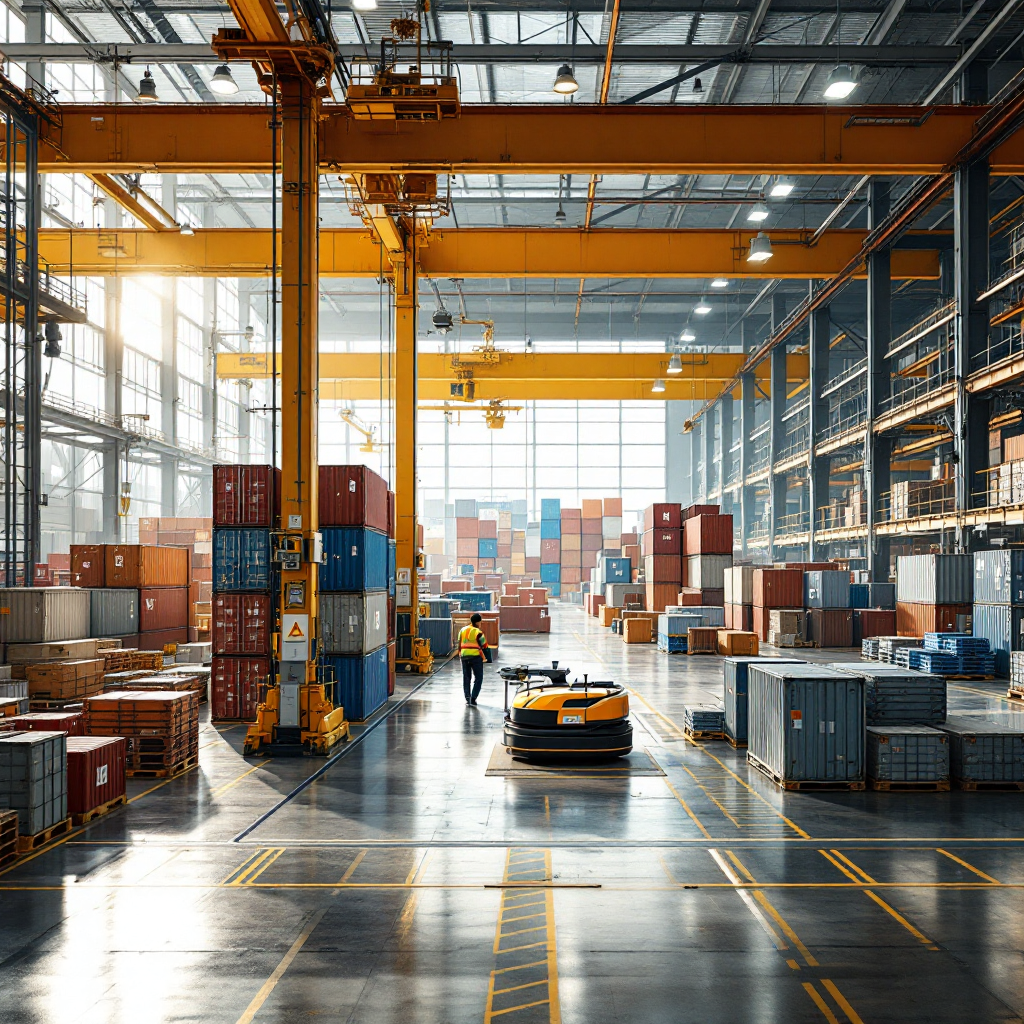
Maritime Perspectives and Case Studies in Container Terminal Yard
Maritime case studies show how yard changes deliver operational gains. A Turkey terminal that applied integer optimization to yard clashes cut handling conflicts by roughly 15% (case study). Large ports that adopt data-driven layouts report throughput lifts consistent with academic predictions. For example, improvements in yard planning can reduce vessel turnaround times and boost terminal throughput by up to 20% (industry analysis). Automated pilot projects in China and Europe highlight savings in crane travel and in reshuffle, and they point toward full automation as a long-term trend.
Case studies also reveal practical constraints. Many ports face congestion at berths and on landside routes. Congestion increases dwell and can create backlogs that empty stacks cannot solve. Terminal teams must manage arrival patterns and must coordinate with carriers and with intermodal partners to smooth peaks. Port operators and terminal operators need to share data early, and they must agree on gate appointment windows to reduce external trucks waiting time. Shared scheduling reduces peaks, and it enables more predictable yard block assignment.
Future trends include wider adoption of AI and advanced sensors, greater intermodal integration, and more sustainable operations. Green port initiatives push terminals to reduce fuel use and to electrify handling equipment. In many projects, AI-based workload balancing for wide-span yard cranes improves resource use while reducing carbon intensity (AI-based workload balancing). The maritime sector also explores machine learning techniques to forecast arrival volumes and to optimize container positioning. As global trade grows, terminals that invest in smart yard designs and in modern terminal control will be better placed to avoid bottleneck and to deliver faster turnaround times. For practitioners, integrating people, process, and technology remains the most reliable route to improved productivity and to sustained competitive performance.
FAQ
What is the primary purpose of a terminal yard?
The primary purpose is to stage containers between ship, road, and rail so cargo moves efficiently through the supply chain. The yard stores containers temporarily and supports operations such as stacking, inspection, and gate handling.
How does yard layout affect throughput?
Yard layout determines travel distances for cranes and trucks and influences reshuffle rates. Better layout reduces travel time and rehandling, which increases throughput and improves turnaround times.
What are common heuristic methods for stacking?
Common methods include genetic algorithms, tabu search, and simulated annealing, which explore many placement combinations and help find near-optimal arrangements. These heuristics are often paired with local stacking rules to respect safety and weight constraints.
How much can optimization reduce vessel turnaround?
Industry studies indicate that improvements in yard planning and resource optimization can reduce vessel turnaround times by up to about 20% (Terminal YardOptimization | OptiFlow Port Solutions). Results vary by terminal and by the specific measures implemented.
What role does the terminal operating system play?
The terminal operating system manages container slots, schedules equipment, and records movements; it coordinates berth, gate, and yard modules. Integration with automation and with real-time feeds ensures the TOS can reassign tasks quickly and reduce manual errors.
Can real-time data cut crane travel distance?
Yes. Real-time tracking using RFID and sensors enables dynamic placement decisions that can reduce crane travel and truck drives, sometimes by up to 20% in optimized settings (automated layout improvements). This directly improves crane productivity and lowers fuel use.
What is reshuffle and how is it minimized?
Reshuffle is the extra moves needed to access blocked containers in a stack. It is minimized by smart slot assignment, by limiting stack height where needed, and by using predictive tools to place soon-to-be-retrieved containers near access aisles.
Are automated container terminals worth the investment?
Automated container terminals can deliver consistent cycles, lower labour costs, and higher throughput when designed for the traffic profile. However, ROI depends on volume, yard design, and integration with existing systems, and terminals must evaluate expected gains carefully.
How do port operators reduce congestion at berths?
Port operators can smooth vessel arrival schedules, implement gate appointment systems for external trucks, and improve coordination with carriers and intermodal partners. Data sharing and real-time replanning also help reduce peaks and prevent bottleneck.
How can terminals start improving yard performance today?
Begin by tracking key performance indicators such as dwell time, throughput, and yard utilization, and then run targeted pilots that introduce data-driven placement and simple heuristics. For many teams, automating routine coordination tasks—such as email-based arrival notices—frees planners to focus on optimization and on exceptions, which accelerates measurable gains.
our products
 stowAI
 stackAI
 jobAI
jobAI
Innovates vessel planning. Faster rotation time of ships, increased flexibility towards shipping lines and customers.
Build the stack in the most efficient way. Increase moves per hour by reducing shifters and increase crane efficiency.
Get the most out of your equipment. Increase moves per hour by minimising waste and delays.
stowAI
Innovates vessel planning. Faster rotation time of ships, increased flexibility towards shipping lines and customers.
stackAI
Build the stack in the most efficient way. Increase moves per hour by reducing shifters and increase crane efficiency.
jobAI
Get the most out of your equipment. Increase moves per hour by minimising waste and delays.