
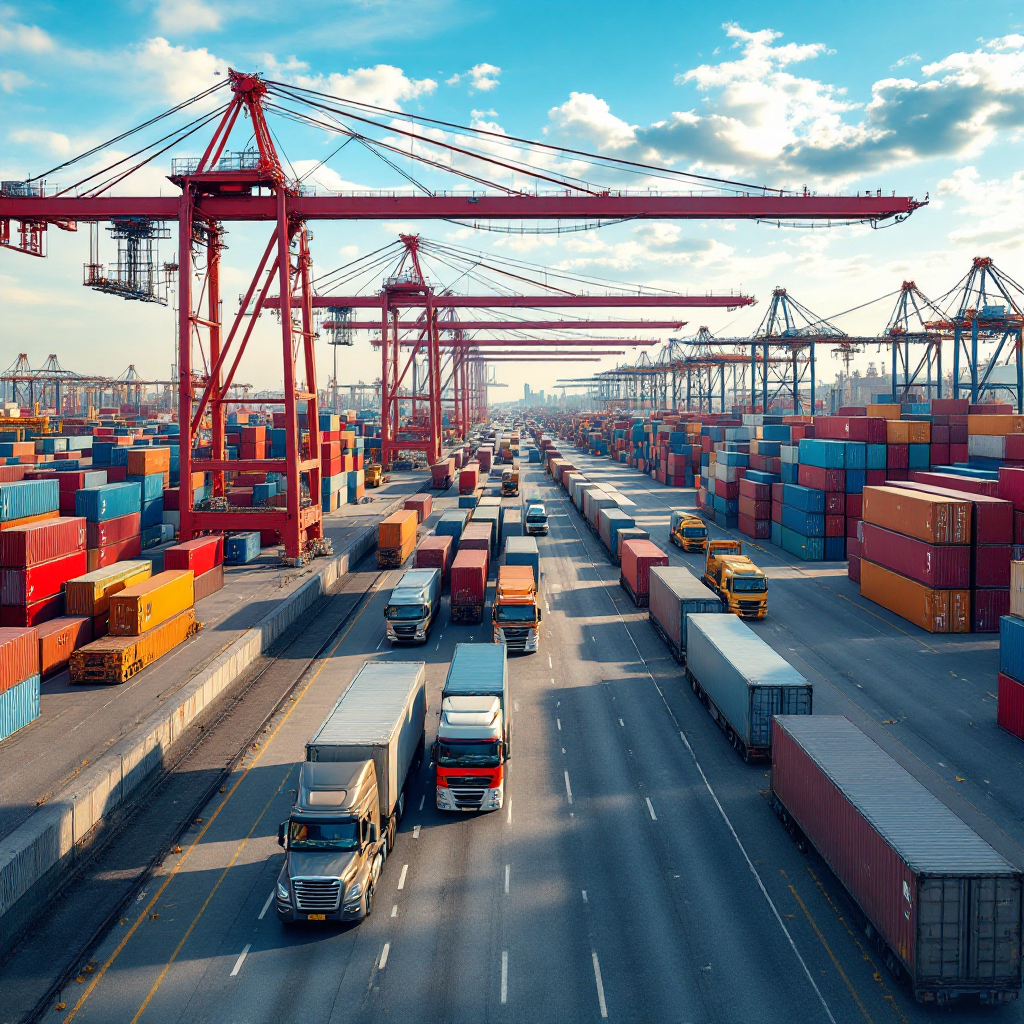
Terminal and Port Operations: Key Challenges and Context
A terminal sits at the heart of global trade. It links ships, trucks, rail and warehouses, and it defines how goods flow through supply chains. For the modern terminal, speed and accuracy matter. For this reason, terminal management must handle high volumes, tight schedules and mixed cargo types. For example, vessel operations and yard moves happen under significant time pressure, so every decision affects cost and service. In the maritime sector, ports face unpredictable factors. Weather, labor availability and equipment faults can trigger a cascade of delays that raise idle time and demurrage. Therefore, terminal teams must plan for variability and keep operations resilient.
Typical port operations include berth allocation, crane cycles, yard stacking, gate checks and hinterland handoffs. Each link can become a bottleneck when demand spikes. For instance, gate congestion increases waiting times for trucks; yard mis-stacking raises reposition moves; and a single crane failure can trigger ripple effects across vessel and truck schedules. Traditional manual planning often relies on experience and spreadsheets. That approach struggles to keep up with real-time variability and multimodal transportation demands. As a result, manual plans can miss opportunities to optimize processes or to prevent costly delays.
Today’s terminals must transform port planning with better tools. A terminal operating systems (TOS) integration layer helps, and ports increasingly explore digitalization strategies to boost efficiency and resilience. For deeper guidance on rolling out digital tools, see our container terminal digitalization roadmap for practical steps and priorities. Also, learning from productivity improvement projects can reduce delays; our container terminal productivity improvement strategies page explains methods that teams apply to raise throughput without expanding land. For medium-sized hubs, smart port solutions can tailor technology to scale and budget while reducing waiting times for trucks and vessels.
To address common challenges, terminals need accurate visibility and faster decision support. In short, the modern terminal cannot rely on intuition alone. Instead, it needs actionable data, connected systems and tools that let teams respond quickly. Thus, the case for a virtual replica of operations grows stronger every year.
Simulation Models and Simulation Software: Building the Digital Replica
Simulation models form the backbone of a virtual replica of a terminal. A simulation model captures layout, equipment parameters, process logic and operational rules so users can reproduce real flows. In practice, engineers define variables in a simulation model such as crane cycle times, truck arrival patterns, processing times at gates and yard re-handling policies. Using these variables, the model plays out scenarios at scale. In short, simulation is a powerful tool for testing changes in a risk-free environment.
Simulation software ingests static data and dynamic feeds to create a living model. First, the software imports the physical layout and asset registry, such as berth lengths, yard blocks and the location of quay cranes. Next, it loads equipment specifications—crane speeds, yard crane reach and truck processing logic—as well as operating rules from terminal operating systems. Then, it injects flow data like vessel calls and truck appointments. This combined set of inputs lets teams reproduce vessel operations and yard activity and then fine-tune policies to reduce moves and waiting times.
Real-time feeds increase model fidelity. When software receives live telemetry, gate scans and terminal operating systems events, it can align the virtual replica with the real terminal. That alignment allows teams to test near-term what-if scenarios and to validate mitigation plans before execution. For practical methods to connect scheduling and stowage with yard planning, see our piece on integrating stowage and yard planning in port operations for examples that often pair with simulation tools.
Using simulation software also supports capacity planning. For instance, operators can ask what happens if vessel arrivals shift by 12 hours, or if crane productivity drops by 15%. The model then quantifies the impact on throughput and on idle time for critical assets. These insights help planners prioritize investments, adjust shift patterns and set guardrails for operational staff. Consequently, simulation models reduce uncertainty and strengthen daily decisions.
Drowning in a full terminal with replans, exceptions and last-minute changes?
Discover what AI-driven planning can do for your terminal
Digital Twin and Port Simulation Software: Architecture and Data Integration
A digital twin differs from a standard model because it links continuously to live systems. Put simply, a digital twin is a dynamic virtual model of a terminal that mirrors live status and behavior. Unlike offline simulations, a terminal digital twin integrates sensors, event streams and historical records so the virtual replica evolves with the real terminal. As one source explained, “A digital twin is a virtual replica of logistics assets, used to simulate terminal operation flows and optimize container movement” (The Intellify) which highlights the role of live alignment.
System architecture for a digital twin typically includes IoT sensors on cranes and gates, a data platform for ingestion and cleaning, a digital twin platform for model execution, and cloud services for storage and compute. IoT devices stream equipment status and location data. Then, a data platform normalizes events and aligns them with the terminal operating systems (TOS). After that, the digital twin platform runs models and offers visualizations for planners. This stack supports integrated decision support and enables continuous simulation of scenarios.
Port simulation software often sits inside this architecture. It accepts telemetry from crane controllers and the TOS, and it outputs performance indicators and recommended actions. When port authorities and terminal operators need to test plans, the digital twin provides a controlled environment that reflects current constraints and priorities. Recent research shows this approach helps assess resilience and sustainable operations by combining daily weather data with operational variables (Digital Twin for resilience and sustainability assessment).
For teams that want to adopt twin platforms, integration with terminal management and the port management information system matters. A robust design keeps latency low, preserves governance and enables granular scenario testing. In practice, teams integrate TOS events, crane telemetry and gate logs so the model can simulate minute-by-minute trade-offs. As a result, port simulation software can mirror real-world activity and recommend short-term interventions that maintain smooth operations.
Port Simulator and Decision Support: Real-Time Control and Prediction
A port simulator turns historical and live data into actionable predictions. Using a port simulator, operators can simulate the effect of a late arrival, an equipment outage or a sudden surge in truck volume. The tool runs many scenarios quickly, and it ranks options so planners can choose the most effective response. In this way, decision support becomes data-driven rather than ad-hoc.
Decision support dashboards present suggested schedules, resource allocations and alerts in a user-friendly layout. Dispatchers see prioritized tasks, while planners review trade-offs between faster vessel operations and higher yard reshuffle counts. For example, a dashboard might recommend reallocating a crane to a specific berth to reduce vessel turnaround, or to delay a yard move to avoid creating a new bottleneck. This kind of fine-tune capability helps reduce idle time for key assets like quay cranes and yard gantries.
Quantified benefits are clear. Simulation studies report throughput improvements of about 15% when terminals adjust flows and resource allocation using virtual models (AAG IT Services). Also, predictive maintenance driven by twin analytics can cut equipment downtime by roughly 25% (Diverse Daily). These results translate into faster vessel turnaround and lower costs per TEU. In addition, using simulation to test policies reduces risk and supports smoother operations during disruptions.
Teams that adopt a port simulator gain the ability to make informed decisions rapidly. For tactical needs, the simulator suggests reallocation or temporary workarounds. For strategic planning, it supports port optimization and capital investment analysis. If you want to reduce crane idle time, see our research on reducing crane idle time in deepsea container ports which ties simulator outputs to operational actions.
Drowning in a full terminal with replans, exceptions and last-minute changes?
Discover what AI-driven planning can do for your terminal
Optimize and Port Optimization: Use Cases in Container Terminal
Use cases for a terminal digital twin range from berth allocation to gate appointment management. In practice, teams apply simulation to berth allocation, yard stacking strategies and gate sequencing. For example, berth allocation tools estimate how changing a vessel’s berth window affects vessel operations and yard congestion. Similarly, yard stacking policies that prioritize near-term retrieval can reduce reshuffles and boost throughput.
Container terminal use cases also include empty repositioning, tandem lift planning and truck appointment smoothing. By testing alternatives in a risk-free environment, operators can optimize port work plans and reduce unnecessary moves. One typical result is a throughput increase near 15% after process and layout changes are validated in a virtual replica and deployed on the ground. In addition, predictive maintenance models integrated into the digital twin help cut downtime by up to 25%, which improves utilization of cranes and yard equipment (Diverse Daily).
Specific solutions often combine TOS rules, AI-based decision logic and simulation. For example, combining a TOS with a twin reduces gate dwell and idle time, and it often lowers truck waiting times during peak windows. Also, teams can optimize processes like empty container flows and appointment controls to minimize driving distances and yard congestion; see our article on reducing driving distances in container port operations for related strategies. Finally, the ability to simulate weather and environmental factors supports sustainable operations and risk mitigation for sensitive berths (resilience research).
terminal simulation supports these outcomes by allowing planners to test changes before committing. In other words, simulations let terminals fine-tune policies, measure trade-offs and then implement changes that boost efficiency and reduce costs across the operation.
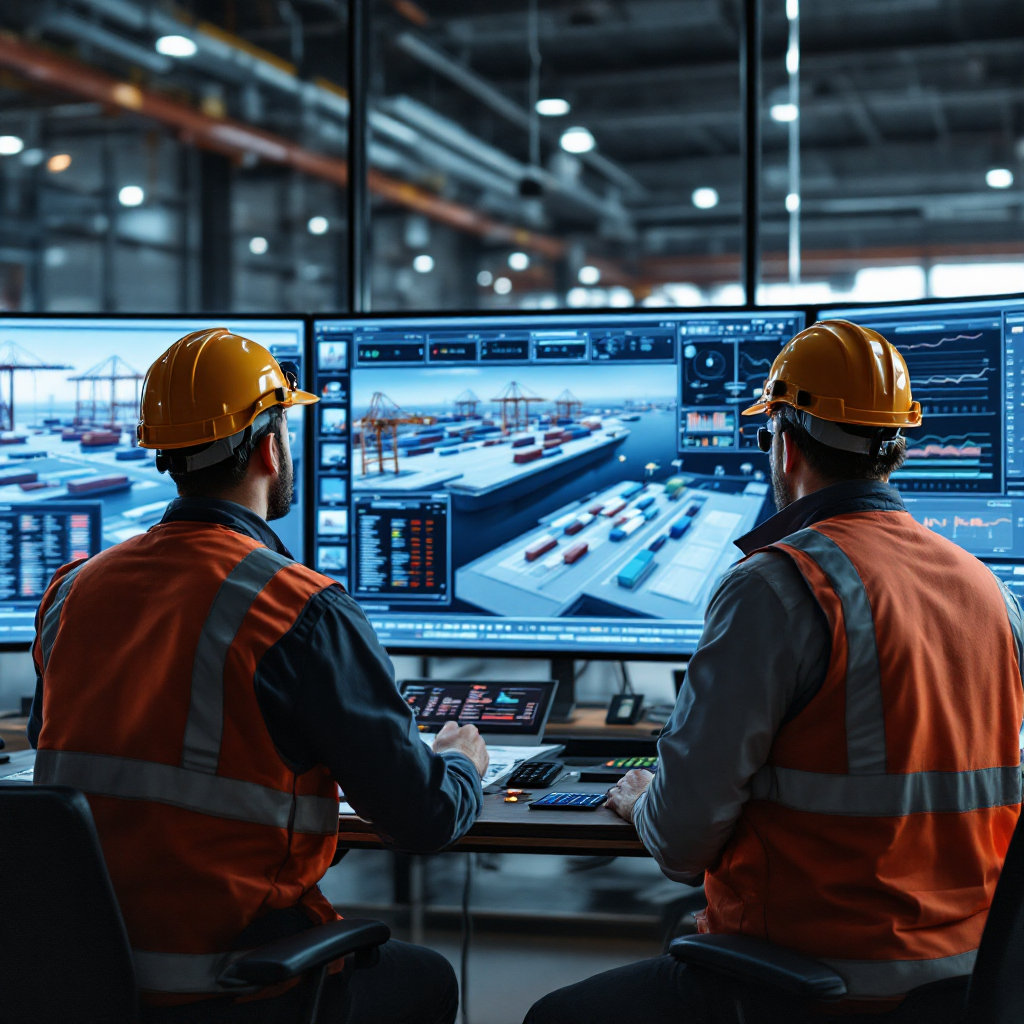
Case Studies: Seamless Integration and Success in Container Terminal
Several terminals report measurable gains after deploying digital replicas. For example, terminals that introduced simulation-based planning saw cost savings in the 20–30% range thanks to better asset allocation and fewer disruptions (AI in Logistics). In addition, improvements in throughput and reduced idle time often come from combining a digital twin platform with TOS updates and operational training. These projects require careful change management to achieve seamless adoption.
A major port that integrated a digital twin noted improvements in visibility and decision speed. The rollout included close integration with the terminal operating systems and the port management information system so planners could trust the model’s outputs. The project phased in simulation-based scenarios for berth planning, then yard stacking, then gate operations. That staged approach helped staff adapt while delivering early wins in vessel turnaround and reduced idle time for quay cranes.
Another example comes from logistics providers who used digital twins to optimize empty container repositioning and truck appointment systems. The simulation modeling helped balance yard utilization and reduced truck idling at the gate. Those projects used a mix of TOS data, historical patterns and live feeds to keep the twin current. The results matched literature findings that simulation-driven changes can boost throughput and cut operating costs (AAG IT Services).
Lessons learned from these case studies emphasize clear governance, data quality and user-friendly dashboards. Also, teams must align incentives between terminal operators and port authorities for smoother rollout. For terminals exploring pilots, tools that link simulation outputs to email and task systems help keep follow-up actions connected. When projects combine robust digital twin design, integrated TOS workflows and automated operational handoffs, they unlock sustained gains in cost savings and smooth operations.
FAQ
What is a digital twin for a terminal?
A digital twin is a dynamic virtual model that mirrors the live state of a terminal. It integrates sensor data, TOS events and historical records so teams can simulate and test plans without impacting operations.
How does simulation improve vessel turnaround?
Simulation lets planners test berth allocation and crane assignments before applying them. As a result, teams can reduce delays and make informed decisions that shorten vessel turnaround time.
Can digital twins reduce equipment downtime?
Yes. Embedded predictive maintenance models in a digital twin identify failure patterns and recommend interventions. These actions can reduce downtime by approximately 25% in many deployments.
Is real-time data necessary for a twin?
Real-time feeds increase fidelity and let the twin mirror current conditions. However, offline simulations remain useful for scenario planning and capacity studies.
How do terminals measure ROI on twin projects?
Terminals track metrics such as throughput, crane idle time, vessel turnaround and cost per TEU. Many projects report cost savings in the 20–30% range after operational changes are implemented.
What integration is needed with a TOS?
Integration should connect the twin to the terminal operating systems for events like gate scans and work orders. That link ensures model outputs align with execution and supports smoother operations.
Can small and mid-sized terminals benefit from twins?
Yes. Smart port solutions can scale to facility size and budget while delivering improvements in gate throughput and yard utilization. Smaller terminals often achieve quick wins by optimizing appointment systems and yard stacking.
Do twins support sustainability goals?
Yes, a twin can simulate environmental factors and test operational changes that lower emissions and energy use. This capability supports sustainable operations and resilience planning.
How long does it take to implement a terminal digital twin?
Implementation time varies with scope and data readiness. A phased rollout that starts with simulation pilots and then integrates live feeds often delivers early benefits within months.
How do teams act on twin recommendations?
Operational recommendations should feed into workflows and communication tools so staff can execute changes quickly.
our products
 stowAI
 stackAI
 jobAI
jobAI
Innovates vessel planning. Faster rotation time of ships, increased flexibility towards shipping lines and customers.
Build the stack in the most efficient way. Increase moves per hour by reducing shifters and increase crane efficiency.
Get the most out of your equipment. Increase moves per hour by minimising waste and delays.
stowAI
Innovates vessel planning. Faster rotation time of ships, increased flexibility towards shipping lines and customers.
stackAI
Build the stack in the most efficient way. Increase moves per hour by reducing shifters and increase crane efficiency.
jobAI
Get the most out of your equipment. Increase moves per hour by minimising waste and delays.