
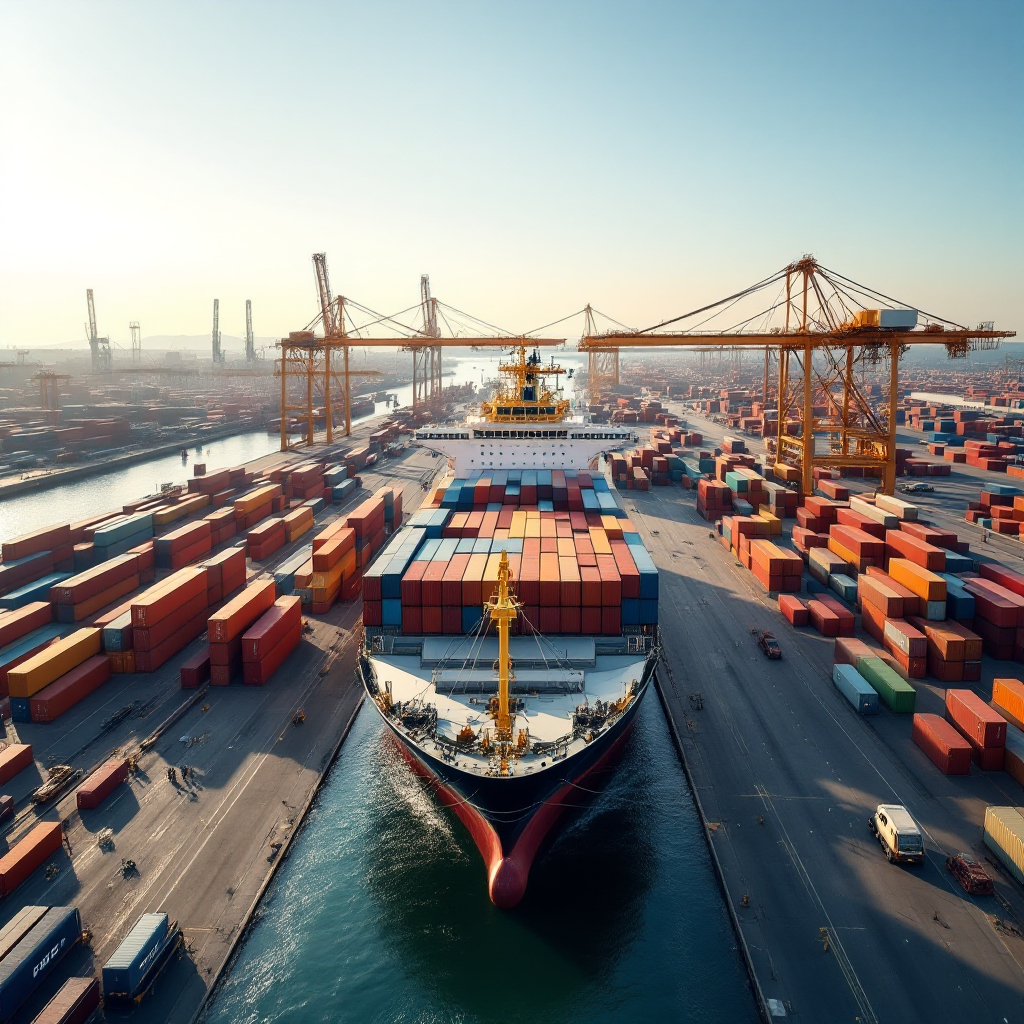
Context: multi-port discharge and the optimization method
A STOWAGE PLAN for a container vessel that calls at several ports must balance many demands. First, the plan must respect weight hierarchies and safety. Second, it must enable efficient LOADING AND UNLOADING at each call. Third, it must limit the number of container movements and also avoid unnecessary reshuffles that slow terminal operations. For inland container liner shipping the stakes are high. Containers sit in stacks. Therefore, a wrong sequence forces extra handling. That extra handling increases vessel turnaround time and port congestion. For example, optimized stowage planning has been shown to reduce container reshuffles by up to 30% and so cut delays and costs [study]. Also, recent guidelines stress that “stacking higher-grade containers on top of lower-grade ones is typically prohibited” to keep operations feasible and safe [quote]. This rule matters for the multi-port master bay plan problem because a top container destined for a later port might block an earlier pickup. Consequently, the optimization method must model port sequence and terminal equipment limits. At the vessel level, a ship stowage plan must respect stability and weight distribution. At the terminal level, quay crane reach and yard stacking rules constrain the plan. For port planners the core challenge is a combinatorial optimization problem. The number of container permutations grows quickly as the number of container and ports increase. Thus, planning problems require robust algorithms. In practice, shipping companies and terminal operators must also align the ship stowage plan with yard retrieval windows. For this reason, collaborative models that integrate the ship and yard side produce better results. When planners receive timely yard confirmations, the ship stowage plan moves faster. Therefore, combining optimized algorithms with improved operational communications reduces friction and improves service reliability.
Constraints and objectives in the optimization method
When you build an optimization method for multi-port calls you must encode constraints precisely. First, safety constraints cover weight limits, center of gravity, and lashing standards. The 2023 Guidelines for Container Stowage and Securing Arrangements emphasize these limits and note that optimized stowage operations “take into account the effects of routes and seasons” in response to ship size growth and advances in lashing technology [guidelines]. Second, port-specific unloading order constraints require that containers destined for an early port must not be buried under later-port containers unless planned shifts are acceptable. Third, terminal equipment constraints include quay crane cycle times, yard crane reach, and the number of available stacks per service. Fourth, container weights and size heterogeneity add combinatorial complexity. For example, stacking a heavy container above a light one violates operations rules and might breach the weight limit or cause instability. Therefore, models often disallow such placements to produce a feasible stowage plan. The main objectives follow from constraints. A key objective is to minimize the amount of container relocation and reduce the number of container movements. In practice, reducing reshuffles by up to 30% materially shortens port calls [statistic]. A second objective is to maximize space utilisation so that fewer slots remain empty and so operating costs fall. A third objective is to ensure ship stability and to respect lashing and safety rules. Modeling these goals turns the assignment problem and allocation problem into a mixed objective optimization problem. Practically, planners may obtain a single-objective optimization problem by scalarizing multiple criteria or by using many-objective formulations to explore trade-offs [research]. Finally, operations in container terminals require alignment with yard operations and quay crane schedules. For related reading on quay crane sequencing and container stacking, see our work on optimizing quay crane operations with container sequencing software quay crane sequencing. Also, yard-side efficiency influences how aggressive a stowage plan can be. See additional context on yard operations and density prediction yard operations and yard density prediction.
Drowning in a full terminal with replans, exceptions and last-minute changes?
Discover what AI-driven planning can do for your terminal
Algorithmic models for the optimization method
Algorithm selection drives results. Integer programming and mixed integer programming have long served stowage planners. Classic integer programming formulations capture slot assignment, weight hierarchies, and loading plan constraints. For example, integer programming models with paired block stowage patterns reduce complexity by grouping containers that share destination ports into blocks. This reduces the effective slot planning problem and simplifies the master bay plan problem. Linear programming relaxations often provide bounds and speed up search. However, pure linear approaches cannot enforce discrete stacking rules. Therefore, modern studies pair integer programming with heuristics. A notable method used in recent research is a Deep Q-Network combined with Large Neighborhood Search (DQN-LNS). This hybrid leverages reinforcement learning to explore promising regions of the solution space, and then applies a neighborhood search algorithm based on systematic removals and reinsertions to refine solutions. Results show marked improvements in reducing the amount of container relocation and in lowering reshuffle rates [DQN-LNS study]. Benchmarks also compare deep reinforcement learning environments and algorithms; those studies propose Gym-like frameworks that allow reproducible testing across scenarios [benchmark]. In parallel, integer programming models that include paired block stowage and constraints for quay crane sequencing show consistent gains in space use and in computation time for realistic problem sizes [benchmark]. For larger instances, decomposition heuristics and hierarchical decomposition reduce memory demand. For example, planners may solve a top-level allocation problem that assigns containers to bays and then solve local stack-level assignment problems. Additionally, genetic algorithm variants sometimes serve as a heuristic for the container stowage when diversity in solutions matters and when time permits. When terminals employ automated stowage and automated handling equipment, planners can embed quay crane and yard crane constraints directly into the integer programming model to produce integrated optimization model outputs. For practitioners who need rapid replanning, exploring neighborhood search methods and compact solution encoding for the container produces practical gains. For more on automated terminal strategies and AGV prioritization see our analysis on automated terminals and AGV job prioritization automated terminal and AGV prioritization.
Collaborative ship and yard process with the optimization method
Better results come when the ship stowage plan and yard retrieval plans link. Thus, an integrated approach aligns loading and unloading on the vessel with container rehandle in yard stacks. First, vessel planners schedule the desired discharge sequence. Second, yard planners ensure that the specific location of a container in the yard matches the ship’s pickup plan. Third, quay crane cycles and yard crane availability sync with truck and feeder schedules. When these elements coordinate, simulation studies report throughput gains of 15–20% in automated terminal environments [collaborative study]. Consequently, coordinating the ship and yard reduces idle crane time and minimizes internal truck travel time. For example, aligning stack retrieval with quay crane cycles decreases waiting and back-and-forth handling. Also, the integration reduces buffer congestions that otherwise cascade into longer port stays. Modern integrations require data exchange and rapid decision loops. Here AI systems that automate communications help. Our AI agents extract booking confirmations, yard availability and crane windows from unstructured emails and then route the data to planners. This automation trims the administrative overhead that used to delay synchronized plans. Furthermore, a well-synced process reduces the container relocation problem and lowers the number of container movements at the berth and in the yard. In turn, this improves quay crane productivity and reduces fuel and labor costs. For more on minimizing internal truck travel and equipment deployment strategies, see our guides on minimizing internal truck travel time truck travel and on optimizing yard equipment deployment yard equipment. Ultimately, collaborative optimisations mean fewer surprises during the port call and more reliable schedules for shipping companies and terminals.

Drowning in a full terminal with replans, exceptions and last-minute changes?
Discover what AI-driven planning can do for your terminal
Integrating industry guidelines into the optimization method
Industry guidance sets mandatory constraints and recommended practices. The 2023 Guidelines for Container Stowage and Securing Arrangements updated rules to reflect larger ships and improved lashing technology [guidelines]. For modelers this matters. First, the guidelines inform weight limit and lashing constraints. Second, they affect the allowable container stack heights on certain routes. Third, they require planners to factor route and seasonal effects into the planning problem in inland and deepsea contexts. When you code constraints into an integer programming model or into a reinforcement learning reward function, you must include these safety conditions as hard constraints. Otherwise, you risk producing infeasible or unsafe stowage plans. For example, a container stack that violates lashing capacity or that places heavy containers improperly may be rejected at inspection. Therefore, algorithmic models should include a stability check and a stowage planning problem with stability test. In practice, planners translate guidelines into parameters such as maximum stack height, allowable gross weight per bay, and maximum lashing loads. Then they impose these parameters in the decision variables. In addition, regulatory compliance affects the ship stowage plan and the master bay plan problem when ports impose local rules. The result is a layered mathematical model that couples combinatorial constraints with physics-based checks. To ensure the model meets real-world operations, testers should simulate loading and unloading sequences using realistic quay crane cycles and terminal equipment capacities. For terminals that pursue automated stowage, the model must also specify exact yard stacking patterns and AGV routing. See our page on optimizing container stacking in terminals for related techniques and case studies optimizing container stacking. Finally, when you calibrate models to guidelines you create robust plans that trading partners and port authorities can accept, which reduces late-stage changes and rework and so helps minimize the total port dwell time.
Case study and performance metrics of the optimization method
Consider a regional inland container terminal that adopted a DQN-LNS hybrid and paired it with an integer programming model for bay allocation. First, the terminal modeled twenty ports on a feeder service and defined container weights and size heterogeneity. Second, planners included quay crane cycle constraints and terminal stack limitations. Third, they integrated yard retrieval windows. The outcome was clear. The optimized container stowage plan reduced reshuffles by up to 30% compared to a baseline heuristic, and it improved space utilisation by 10–25% depending on service mix [results]. Also, the collaborative model delivered a throughput improvement of roughly 15–20% in automated terminal simulations [simulation]. Operational lessons included three points. First, early integration of yard and ship planners avoided last-minute rehandles. Second, encoding weight rules as hard constraints prevented infeasible stowage plans. Third, compact solution encoding for the container and decomposition heuristic for the container reduced runtime on large instances. In practice, planners combined integer programming with a neighborhood search algorithm and used a suspensory heuristic procedure to handle exceptional moves. They also used a simple assignment problem formulation for the top-level bay allocation, and then refined stacks via local search. For shipping companies the return on investment showed as lower crane idle time and fewer penalties for delayed cargo. For terminals the gains appeared as increased quay crane throughput and reduced internal truck travel. A practical recommendation is to run the optimization method in a testbed that mirrors real equipment, and to update parameters based on seasonal changes. For case studies and implementation tips related to ramping up AI in terminal operations, see our guides on digital twin technology and terminal KPIs digital twin and terminal KPIs. This shortens the time from model recommendation to executed ship stowage and yard retrieval.
FAQ
What is a stowage plan and why does it matter for multi-port calls?
A stowage plan assigns specific containers to slots on a vessel to match the sequence of port calls and safety rules. It matters for multi-port calls because poor placement causes extra shifts, longer quay times, and higher costs.
How do weight hierarchies affect stowage planning?
Weight hierarchies prevent heavy containers from being stacked above lighter ones to maintain stability and comply with lashing standards. They also affect feasible stack heights and therefore the allocation problem in planning.
What algorithms are effective for multi-port stowage planning?
Integer programming, mixed integer programming, and hybrid approaches like DQN-LNS are effective depending on problem size and time limits. Heuristics and neighborhood search algorithms speed up solutions when exact methods prove too slow.
Can collaborative planning between ship and yard improve results?
Yes. When ship stowage plans align with yard retrieval schedules, simulations show throughput gains of 15–20% in automated environments [study]. Coordination reduces idle crane time and unnecessary container movements.
What role do industry guidelines play in stowage optimization?
Guidelines set safety and lashing limits that must be encoded as hard constraints in models. The 2023 Guidelines require planners to account for route and seasonal effects and larger ship sizes [guidelines].
How much can optimized stowage reduce reshuffles?
Studies report reshuffle reductions up to 30% when using advanced optimization methods and better coordination [data]. Actual gains depend on terminal layout and service patterns.
Is reinforcement learning ready for production stowage planning?
Reinforcement learning shows promise, especially in DQN-LNS hybrids, and benchmarks suggest reusable environments for testing [benchmark]. However, many operators prefer hybrids that combine RL with proven mathematical models.
How do terminals validate a feasible stowage plan?
Terminals validate plans by simulating loading and UNLOADING sequences, checking stability, and verifying crane reach and yard constraints. They also run spot checks against regulations and adjust parameters for seasonal changes.
What quick wins can shipping companies expect when adopting these methods?
Quick wins include fewer rehandles, faster berth turns, and better quay crane utilization, which together reduce turnaround time and operating costs. Better communication tools that automate confirmations further accelerate implementation.
How can automation tools help in the planning workflow?
Automation tools extract and route operational data, reducing manual email triage and errors.
our products
 stowAI
 stackAI
 jobAI
jobAI
Innovates vessel planning. Faster rotation time of ships, increased flexibility towards shipping lines and customers.
Build the stack in the most efficient way. Increase moves per hour by reducing shifters and increase crane efficiency.
Get the most out of your equipment. Increase moves per hour by minimising waste and delays.
stowAI
Innovates vessel planning. Faster rotation time of ships, increased flexibility towards shipping lines and customers.
stackAI
Build the stack in the most efficient way. Increase moves per hour by reducing shifters and increase crane efficiency.
jobAI
Get the most out of your equipment. Increase moves per hour by minimising waste and delays.