
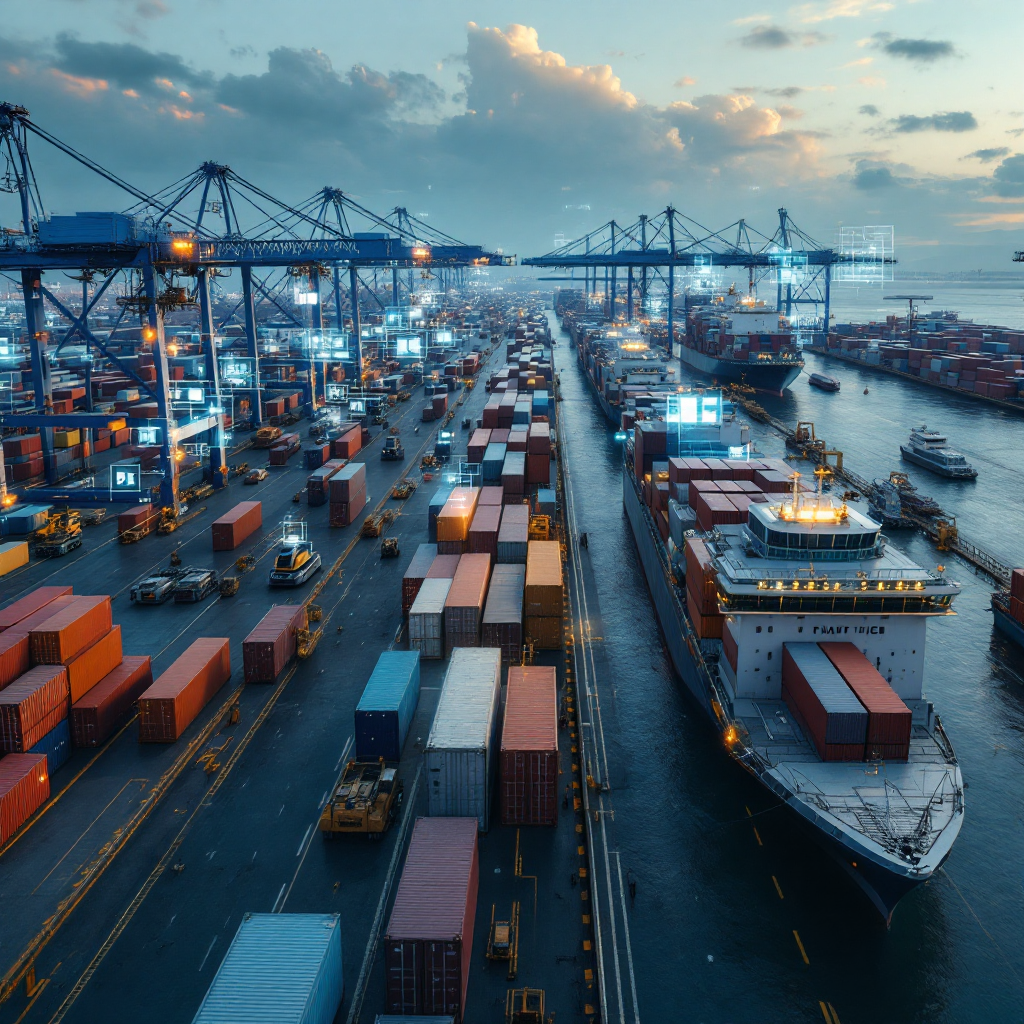
Programmable Logic Controllers (PLCs) and PLC Data: The Foundation of Container Terminal Automation
Programmable logic controllers sit at the core of modern container terminal control. PLCs monitor inputs from SENSOR arrays and then drive outputs to CRANES, conveyor belts, and automated guided vehicles. They read switches and encoders, they measure vibration and temperature, and they issue actuation commands to MACHINERY. This continuous stream of PLC data supplies equipment status, health signals, and environment readings. Therefore AI systems can act on BASED ON REAL-TIME DATA feeds and provide fast feedback to operators.
PLCs run ladder logic or structured text and they integrate with higher-level systems through SCADA or OPC-UA. Container terminal teams rely on PLC programming to implement low-latency control logic for automated cranes and vehicles. In ports that upgrade PLCs, technicians keep hard real-time control local, and then forward aggregated telemetry to analytics platforms. That split lets advanced analytics run in the cloud while controllers keep deterministic response.
The market behind this foundation shows strong momentum. For example, the global PLC market was valued at USD 11.7 billion in 2024 and is projected to reach USD 31.4 billion by 2034 (market report). That growth reflects demand for smarter PLC systems and wider INDUSTRIAL AUTOMATION adoption. Meanwhile, compact PLC solutions and IoT-ready units extend capabilities to retrofitted terminals (industry forecast). As PLCs multiply, the volume of sensor data and operational telemetry available to AI rises sharply.
Operators therefore see PLCs not only as controllers but as data sources. PLC systems feed status pages, and they feed AI pipelines. When operators combine PLC telemetry with yard management and vessel schedules, they gain visibility across the supply chain and across container terminal operations. For teams building smarter ports, this foundational PLC layer underpins every later AI application and every effort to enhance operational efficiency and safeguard assets.
AI-Driven Analytics and Application of Artificial Intelligence to Optimise Throughput
AI ingests PLC streams to find patterns and then to recommend actions. First, data pipelines collect SENSOR DATA and then they clean and label it for machine learning models. Next, AI algorithms identify recurring delays, idle cranes, and suboptimal stack placements. Then planners use those insights to reschedule crane moves and adjust yard layouts so throughput improves and queuing drops. In pilot deployments, terminals reported measurable throughput gains and shorter vessel dwell times when they combined live PLC telemetry with scheduling AI (consultancy).
Many manufacturers moved early to IOT-integrated PLC solutions, which accelerated the adoption of AI in operations. In fact, over 70% of manufacturers in North America and Europe had adopted IoT-enabled PLCs by 2025, and ports have mirrored that trend as they pursue smart port programs (market analysis). As a result, teams now have higher-fidelity inputs for predictive analytics and scheduling models.
Concrete use cases include dynamic crane assignment, tandem lift sequencing, and optimized portal-trolley deployment. For deeper techniques, terminals apply machine learning models to predict container arrivals and then to sequence yard moves accordingly. If an AI model forecasts a surge, then the system pre-positions containers and reduces idle time. For further reading on workload balancing between wide-span yard cranes, see a practical study on AI-based workload balancing for wide-span yard cranes (AI-based workload balancing).
Operators and planners use AI-driven analytics to reduce manual triage and to increase predictability. For instance, automated email agents surface PLC alarms and then attach the right telemetry and operational context to the message, so an operator can act faster and with full context. Finally, the application of AI to optimize throughput ties together PLC telemetry, vessel schedules, and yard rules into a cohesive, adaptive process.
Drowning in a full terminal with replans, exceptions and last-minute changes?
Discover what AI-driven planning can do for your terminal
Predictive Maintenance, Anomaly Detection and Edge AI for Equipment Reliability
Predictive maintenance relies on rich PLC feeds and on advanced analytics. AI algorithms to predict container wear and failures analyze vibration, temperature, and usage patterns, and then they forecast equipment failures before they occur. Predictive maintenance systems flag units with rising trends, and maintenance crews can plan interventions during slack periods. This approach helps to reduce planned and unplanned downtime and to lower cost of repairs.
Anomaly detection models scan PLC signals for behavior that strays from expected norms. For example, a change in motor current combined with a spike in temperature might indicate bearing wear. The model then issues an alert and routes the ticket to an operator or to a maintenance team. That workflow cuts mean time to repair and increases MTBF. These systems pair well with edge AI, which performs inference near the PLC and therefore reduces LATENCY and bandwidth use.
Edge AI deployments let terminals run AI-powered logic on site, close to PLCs and sensors. Local inference can decide whether to trigger a shut-down, reduce speed, or schedule a check. By contrast, cloud-only systems can introduce delays and can increase data transfer costs. Edge inference therefore complements cloud analytics and it supports high-availability control. For guidelines on predictive equipment repositioning and minimizing non-productive moves, terminals can consult predictive equipment repositioning research (predictive repositioning).
Operators see measurable value. Pilots report fewer emergency repairs and lower spare parts consumption after they deploy combined PLC-driven predictive maintenance and anomaly detection. Teams also document cost savings from avoided breakdowns and from more efficient maintenance schedules.
Revolutionise Operations with AI-Powered Controller and Programmable Logic Integration
AI-powered controllers augment traditional PLCs and they extend control logic in real time. Rather than replacing ladder logic or PLC programming, AI augments it. For instance, an AI layer can suggest adaptive crane trajectories and then hand off final motion commands to the PLC. That split keeps safety-critical control within the deterministic PLC while the AI proposes performance improvements.
Operations with AI can adapt yard layouts and sequencing dynamically. An AI system can reassign stacks, schedule tandem lifts, and optimize split tasks between cranes to reduce non-productive moves. When AI and PLCs integrate tightly, terminals raise uptime and they improve operational efficiency. Additionally, these integrations can increase MTBF and reduce fault propagation across subsystems.
Programmable logic controllers and programmable logic gain new roles when paired with AI. Engineers extend PLC development to feed richer feature sets into AI systems and to accept AI recommendations through defined interfaces. This evolution calls for robust control APIs and for cybersecure handshakes between AI systems and controllers. For a review of container terminal housekeepings, such as stack shuffling that AI can help with, see automated container terminal housekeeping and stack shuffling strategies (housekeeping and stack shuffling).
Quantified benefits include higher uptime, fewer stoppages, and longer equipment life. Vendors and operators report increases in availability and in throughput when they combine AI-driven automation with deterministic PLC control. That combination helps to revolutionize traditional terminal operations and to support the ongoing advancement of industrial environments.

Drowning in a full terminal with replans, exceptions and last-minute changes?
Discover what AI-driven planning can do for your terminal
Industrial Automation in Smart Ports: Computer Vision and Beyond
Container terminals form a central use case for industrial automation and for smart port initiatives. Computer vision systems identify container numbers, inspect damage, and then map yard occupancy. When CV systems feed labels into AI models, they supply extra context that complements PLC telemetry. For example, a camera can confirm a misaligned spreader while PLC signals show an unexpected torque spike. Together, these inputs allow rapid root-cause analysis.
Computer vision integrates with PLC systems and AI systems to orchestrate end-to-end port operations. The system correlates vision events with CRANE positions and with AGV routes. That correlation helps planners and operators to reduce container handling times and to mitigate human error. Several smart-port pilots have shown measurable drops in handling time and in misloads when CV and PLC data were combined with predictive analytics (consultancy).
Beyond CV, terminals apply advanced machine learning and robotics for yard mapping and for automated inspections. Machine learning models detect container damage and then flag containers for manual review. Those machine learning models run alongside AI algorithms that predict container volumes and that help schedule resources. For deeper technical use cases, see machine learning use cases in port operations (ML use cases).
Smart port deployments also explore digital twins and 5G-enabled edge AI. Digital twins pair live PLC telemetry with physics-based simulation and with AI-driven what-if analysis. That setup helps planners to test yard reconfigurations without risking real assets. In time, these capabilities will tighten links between industrial automation, supply chain forecasts, and port performance.
Benefits of AI and Challenges of Implementing AI in Container Terminal Automation
AI adoption brings higher throughput, improved safety, and reduced costs. AI-driven automation shortens vessel berthing times and it helps to reduce container moves that add no value. Predictive analytics and predictive maintenance lower unplanned downtime and extend equipment life. In short, AI technologies generate cost savings and operational efficiency across the terminal.
Yet implementing AI and automation also presents challenges. Operators must standardize data formats and then integrate diverse PLC systems into a single pipeline. Cybersecurity risks increase as more devices join the network, so teams must safeguard access and enforce encryption. Model complexity and explainability also matter because operators need transparent recommendations and clear audit trails. For guidance on consistent planning quality across shifts and on safe implementation, operators can consult planning and safety resources such as consistent planning quality across terminal operations shifts (planning quality).
Best practices include unified data schemas, robust security protocols, and scalable AI-PLC architectures. Teams should design interfaces that keep fast control local to the PLC and that let AI propose non-safety-critical optimizations. Also, teams must validate machine learning algorithms on labeled field data and then monitor models in production. Implementing ai responsibly means combining human oversight with automated detection and escalation paths.
Looking ahead, the integration of AI with PLCs will advance the future of industrial automation. Digital twins, stronger edge AI, and better PLC development will allow terminals to predict container volumes and to rebalance yard resources automatically. When terminals embrace these practices, they support global trade and they ensure more resilient port operations.
FAQ
What role do PLCs play in container terminal automation?
PLCs provide deterministic control for cranes, conveyors, and AGVs, and they collect sensor data that AI uses for analytics. They run ladder logic or structured text and they act as the real-time backbone for control logic at ports.
How does AI use PLC data to optimize throughput?
AI ingests PLC telemetry and then identifies inefficiencies in crane scheduling and yard stacking. By predicting bottlenecks and proposing rescheduling, AI helps operators increase gross moves per hour and reduce vessel dwell time.
Can predictive maintenance really reduce downtime?
Yes. Predictive maintenance uses vibration and temperature trends from PLCs to forecast failures and to schedule repairs during slack periods. Operators report fewer emergency repairs and improved MTBF after deployment.
What is edge AI and why does it matter for ports?
Edge AI runs inference close to PLC systems, which reduces latency and lowers bandwidth costs. That local inference supports fast safety decisions and keeps critical control loops responsive.
How do computer vision systems work with PLCs?
Computer vision identifies containers and inspects damage, and then it correlates results with PLC signals for root-cause analysis. Together, they enable automated inspection workflows and faster exception handling.
What are the main challenges when implementing AI in terminals?
Key challenges include data standardization, cybersecurity, and ensuring model explainability. Teams must also design architectures that keep safety-critical control inside PLCs while allowing AI to recommend optimizations.
Are there measurable benefits from AI pilots in ports?
Yes. Pilots often show higher throughput, lower handling times, and reduced container misloads when AI combines PLC telemetry with scheduling analytics. Consultancy reports document these outcomes in several smart-port trials.
How can operations teams manage alerts and emails from AI systems?
That automation reduces triage time and ensures consistent, data-grounded responses.
Will AI replace human operators at terminals?
No. AI augments operators by handling repetitive tasks and by providing recommendations, but humans retain oversight and final control for safety-critical actions. Operators remain essential for exception handling and strategic decisions.
What does the future hold for AI and PLC integration in ports?
The future includes tighter AI-PLC convergence, 5G-enabled edge AI, and wider use of digital twins for what-if analysis. These advancements will help terminals predict container volumes and optimize resources across the supply chain.
our products
 stowAI
 stackAI
 jobAI
jobAI
Innovates vessel planning. Faster rotation time of ships, increased flexibility towards shipping lines and customers.
Build the stack in the most efficient way. Increase moves per hour by reducing shifters and increase crane efficiency.
Get the most out of your equipment. Increase moves per hour by minimising waste and delays.
stowAI
Innovates vessel planning. Faster rotation time of ships, increased flexibility towards shipping lines and customers.
stackAI
Build the stack in the most efficient way. Increase moves per hour by reducing shifters and increase crane efficiency.
jobAI
Get the most out of your equipment. Increase moves per hour by minimising waste and delays.